
The share price is generally the first thing that we notice when checking a company we want to trade. Yet, this only tells us part of the story, with the size of the market cap letting us more fully understand what kind of investment opportunity it represents.
Trade classifies companies by size, since this gives us a better idea of the scale of the business, growth potential and stability. We’ll be looking at what the company market cap means and how you can use this information to make informed decisions.
What Is Market Cap? Definition and Meaning
We need to start by looking at the market cap meaning, before going on to see what it’s used for. This is a measure of a company’s real size, shown as a monetary value. It’s one of the most crucial figures that you need to understand when you want to trade shares.
Rather than being fixed, it’s determined by the way the market moves. Since it includes the share price, which constantly fluctuates, this is a dynamic measurement that changes according to the current price.
We also take into account any change to the number of shares outstanding. While this is a less dynamic figure than the share price, it can still change from time to time.
A company with a large number of shares and a low share price should have a steady market cap. If the share price is high but there are relatively few shares, the market cap might be the same as in the first example, but it will probably be more volatile.
Taking both of these elements into account gives us a way to measure company size accurately at any moment. However, what it doesn’t do is tell us about their total revenue or assets. We also can’t tell if they’re in profit or making a loss. It’s simply letting us measure company size in terms of its total equity value.
How Is Market Capitalization Calculated? Formula and Examples
While it sounds complicated, the market capitalisation formula is actually incredibly simple. It only takes a moment to see how to calculate market cap numbers and then put it into practice.
To calculate the stock market cap of a business, we need to carry out the following calculation: Market Cap=Current Share Price×Total Number of Shares Outstanding. We can therefore look at the market cap definition as being the public value of the company.
Let’s imagine that a company has 1 million shares and each one costs £10. That would make a market cap of £10 million. This figure will vary according to the way the market price goes up or down. However, the changes are likely to be relatively small unless the number of shares is altered greatly.
By understanding the market cap calculator, we can see that the share price isn’t an indicator of the size of the company. While some people believe that a large share price means a giant, profitable business, this price only tells us part of the story. If there are few shares, then the market cap will be modest.
In the same way, we’ve shown that a cheap stock can be part of a billion-pound business if there are lots of shares issued. It just needs enough shares issued to create a high market cap. This is a factor to take into account when carrying out fundamental analysis on a stock you’re interested in knowing more about.
Large Cap vs Mid Cap vs Small Cap Stocks
The company market cap gives us a clear indicator of the size of the business. This information can be used to understand issues such as the stability, liquidity, volatility and growth potential of the company.
Businesses are generally divided into large-cap, mid-cap and small-cap groups as a way of understanding how they may move. While there is no official threshold for these categories, the following are guidelines to help you understand why this matters.
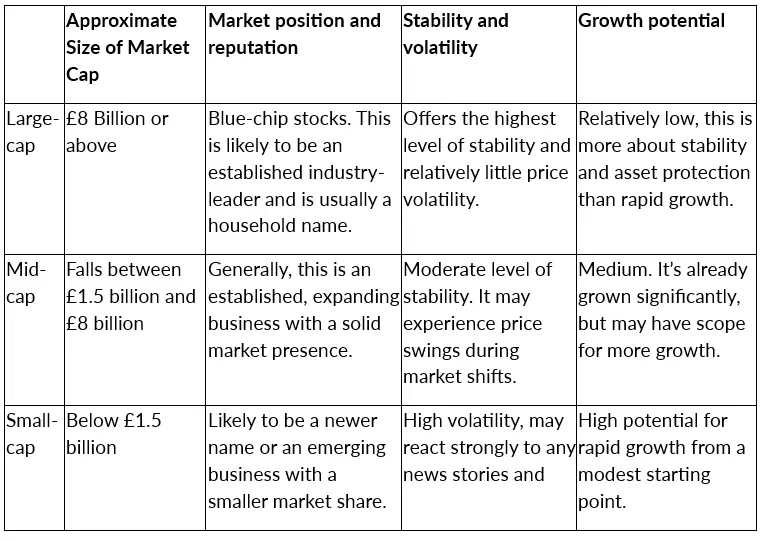
As we can see, the risk-return trade-offs vary significantly according to the market cap classification. This means that you can use this calculation and classification when choosing the risk level and potential return that you’re most comfortable with.
Having a mixed portfolio with some shares from each category is a popular strategy. However, a risk-averse investor who is most interested in protecting their capital may decide to only buy large-caps.
Market Cap Rankings and the Largest Companies by Market Cap
Looking at the largest companies by market cap gives us an easy way to see which businesses dominate the stock market. Traders keep a close eye on the large-cap companies, since they have more market influence and a greater weighting in stock indices.
While market caps change all the time depending on share price movements, the biggest market cap companies tend to stay at the top of the list for years since they’re so well-established.
Traders pay a lot of attention to the names at the top of the market cap ranking. Indices like the FTSE 100 and the S&P 500 are market-cap weighted. What this means is the companies leading this category have a much bigger effect on the overall market.
If a large-cap stock has a major drop in its price, this can drag down the whole index. Traders look at these companies as a way of trying to predict future trends. The highest market cap companies often have a global presence across various industries, meaning that they let us see the bigger picture.
They may also act as safe havens for investors who want a period of stability. If the overall market is going through a period of uncertainty, they may see the large-caps as being the safest option.
Market Capitalisation FAQs for Traders
Can Understanding Market Cap Help You Diversify Your Portfolio?
Yes, this is a way of trading different types of companies, which will be exposed to different kinds of risks. Higher-cap companies tend to be more stable and less volatile, but may provide fewer growth opportunities.
What is the difference between a Company Market Cap and Enterprise Value?
We’ve seen that market cap is the current share value multiplied by the number of shares. Enterprise value takes into account this market cap but also adds total debt before subtracting any cash reserves. This gives a more accurate figure of what would be needed for a takeover or buyout.
Can a Small Company Have a High Market Cap?
While market capitalisation is the main tool that investors use to measure a company’s size, it doesn’t reveal the full details of the physical size of the business. A fast-growing company may attract large investors that boost its market value before it undergoes physical growth in terms of new premises.
Does the Market Cap Influence a Company’s Share Price?
Not directly, but it does play a role in terms of the expected price volatility. The price of a small-cap can be moved more easily, while a large-cap business requires massive trading volumes to cause a major price change to occur.
The information provided does not constitute investment research. The material has not been prepared in accordance with the legal requirements designed to promote the independence of investment research and as such is to be considered to be a marketing communication.
All information has been prepared by ActivTrades (“AT”). The information does not contain a record of AT’s prices, or an offer of or solicitation for a transaction in any financial instrument. No representation or warranty is given as to the accuracy or completeness of this information.
Any material provided does not have regard to the specific investment objective and financial situation of any person who may receive it. Past performance is not a reliable indicator of future performance. AT provides an execution-only service. Consequently, any person acting on the information provided does so at their own risk. Forecasts are not guarantees. Rates may change. Political risk is unpredictable. Central bank actions may vary. Platforms’ tools do not guarantee success.