
For the third time in 4 years, we find ourselves in the midst of a war, and of course, that changes a lot as far as the markets are concerned.
You can see this in the behaviour of volatility indices, which effectively track the propensity of their underlying instruments to generate large and/or irregular price swings. There are several excellent examples below.
Volatility indices are expressed as percentages, so they range between 0 and 100.
We will rarely, if ever, see these indices print at the boundaries; instead, they tend to trade in relatively tight ranges with occasional spikes higher.
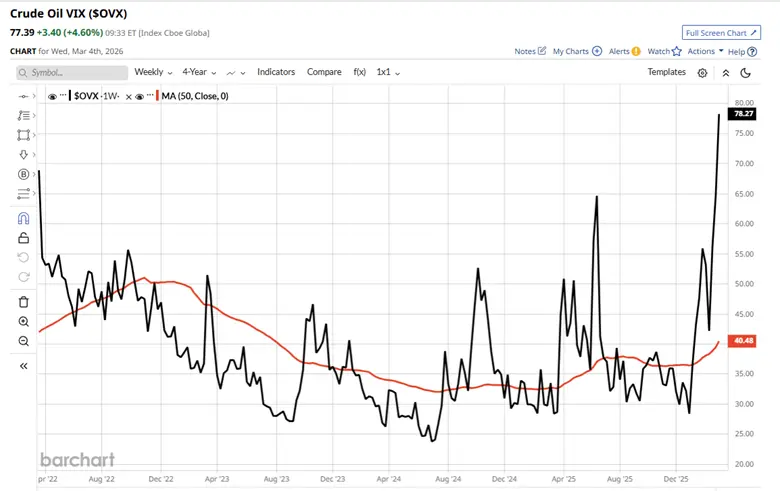
If we look back over 10 years in WTI, the 50-period MA for the Crude VIX has largely ranged between 30 and 40%. Though it’s spiked to far, far higher levels than that since the US attacked Iran.
Crude oil volatility jumped sharply.
Source: Barchart.com
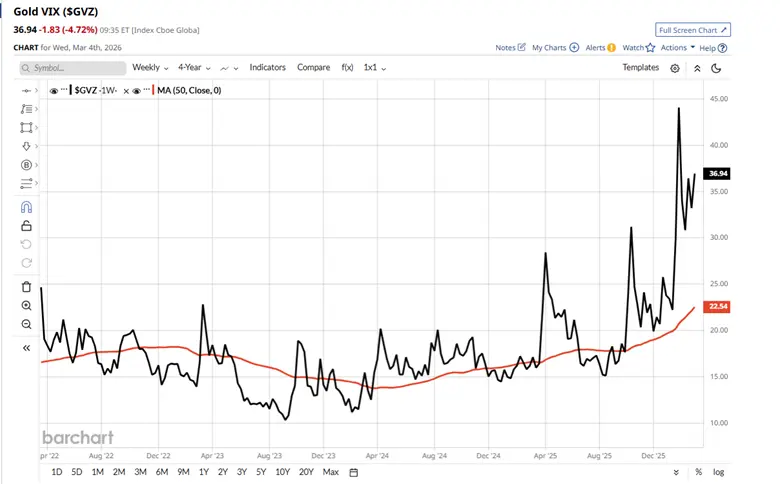
The Volatility of Gold also spiked higher after the American attacks.
Source: Barchart.com
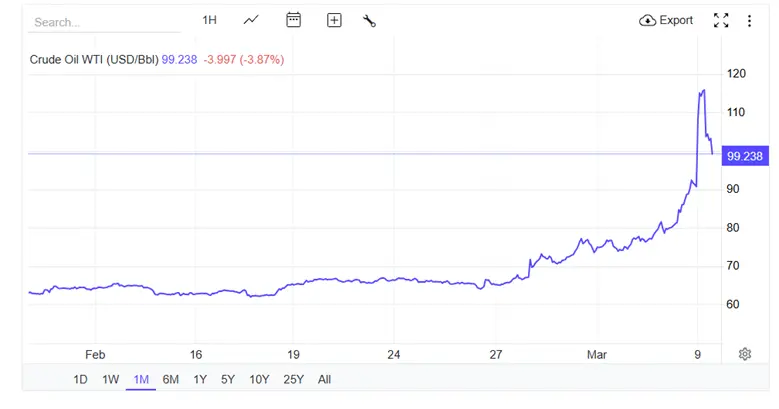
The price of US, or WTI, crude has spiked sharply as the war with Iran continues.
Source: Trading Economics
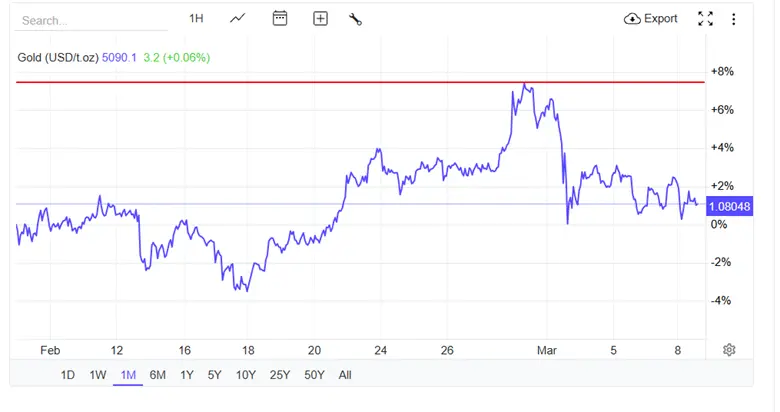
Gold prices have actually fallen, showing just how uncertain the markets are feeling right now.
Source: Trading Economics
When market dynamics change, so should your approach to risk.
Uncertainty raises volatility, prices become more volatile and harder to predict. Previous ranges and other statistics about price action become less effective because the psychology of traders changes in these situations. Where traders were outright bullish, they became more cautious, and if fear gets a grip, then it can oust greed and create bearish sentiment.
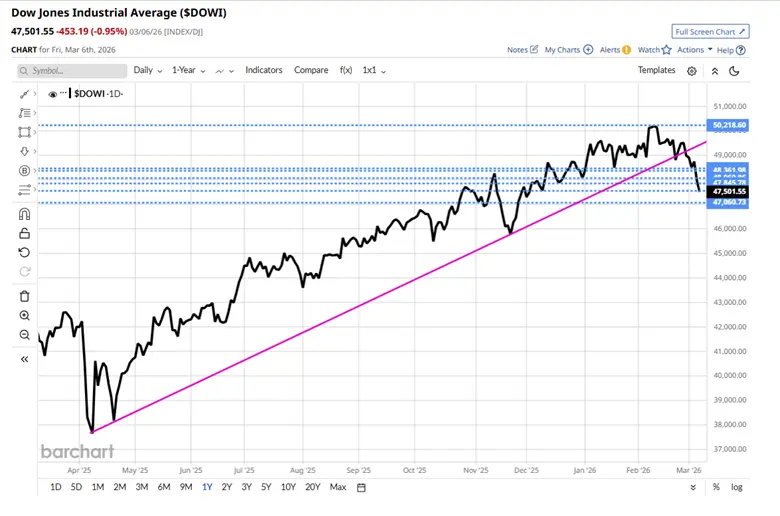
You could argue that this is what has happened to the Dow 30 in recent sessions, and the uptrend in the index that dates back to early April 2025 has been stopped in its tracks.
When the dynamics and sentiment in the market experience abrupt changes, then as traders we need to modify our behaviour as well. And in particular, we need to reassess our approach to risk.
Higher risk in the market means that there is more room for error, which in turn means it becomes harder to slant the odds of success in a trade, in your favour.
Or to put it another way, it becomes even easier to lose money on a trade.
In those circumstances, traders should take sensible precautions, for example, reducing their trade size and their overall risk exposure.
If your standard trade size is 2.0% of your account balance, reducing it to 1.0% will cut your exposure by 50.0%. And if you normally allow yourself a maximum of 5 open positions at any one time, reducing that number to just 3 open trades at once, you have reduced your exposure by 40.0%.
These measures won't stop you from losing money on a trade if you are wrong, but they should help you to lose less.
Capital preservation and longevity are the two most important goals for a trader.
Protecting your capital and being exposed to the largest number of trading opportunities, over the longest period of time, is what all traders should be aiming for.
Modifying your trading behaviour in periods of increased risk and uncertainty makes perfect sense.
Here are some other risk management ideas:
Be more selective: only look for high or very high quality set-ups, and take only the trades that you have the highest conviction in, rather than chasing every spike or plunge.
Look for confirmation from your indicators; they should back up what the price action/chart setup is telling you about a trade. If that's not the case, then don't take the trade at all.
Trade in only the most liquid stocks and instruments, as volume can quickly disappear from the markets in times of uncertainty, as traders take a step back. Lower volumes are often associated with wider spreads and bigger price moves and or gapping.
Traders should always aim to be able to enter or exit a trade with relative ease.
What comes next?
Oil prices look likely to remain elevated while the war continues, and a large portion of the world's natural gas is also exported from the Middle East. With the continuity of those supplies now in doubt gas prices have jumped sharply.
UK natural gas is trading up by +101.50% over the last month, whilst Dutch TTF gas is up +85.14% in that time frame.
Higher energy prices feed directly into the economy, of course, fueling inflation, pushing up costs for businesses and industry. Rising costs and uncertainty make businesses cautious.
What might this mean for the markets going forward? Might we see a bigger seller off in equities, for example?
Interestingly, analysts at Deutsche Bank recently looked at the history of energy shocks and their relationship with larger drawdowns in the S&P 500.
They found that falls of 15.0% or more in the S&P needed at least one of three criteria.
A spike in the oil price of between 50.0% and 100.0% that lasted for several months.
Central bankers moving to tighten interest rates and restrict monetary policy.
A weakening economy tipped into recession by the energy price rise, as was the case following the Gulf War of 1990.
Where are we now?
Right now, oil prices have spiked substantially, but they have only done so in the near term.
For example, spot WTI is up +42.90% over the last month, whilst WTI futures for November 2026 show a rise of just +16.34%, and for March 2027, the 1-month gain is +11.33%.
Interest rates do look to be on a more hawkish path, with central banks pausing rate cuts, or at least waiting to see what the data tells them before making any changes to policy.
That pause has been bought by a mixed economy, which is slowing in some sectors but booming in others. However, to my mind, central bankers will want to keep rates as low as they can for as long as they can, while there are external pressures on the economy.
For example, the Fed has reduced the number of rate cuts it's made, but it hasn’t raised rates yet.
We have seen weaker economic data of late, but it's not been related to issues in the Middle East; However, it would be wrong to become complacent.
Watch data from the major economies and, in particular, look out for any unexpected or continuing disappointments, and data that hints at a continuing economic slowdown.
Rising unemployment, falling investment and spending (both domestic and corporate), and levels of inflation are all things to watch closely from here.
The information provided does not constitute investment research. The material has not been prepared in accordance with the legal requirements designed to promote the independence of investment research and as such is to be considered to be a marketing communication.
All information has been prepared by ActivTrades (“AT”). The information does not contain a record of AT’s prices, or an offer of or solicitation for a transaction in any financial instrument. No representation or warranty is given as to the accuracy or completeness of this information.
Any material provided does not have regard to the specific investment objective and financial situation of any person who may receive it. Past performance is not a reliable indicator of future performance. AT provides an execution-only service. Consequently, any person acting on the information provided does so at their own risk. Forecasts are not guarantees. Rates may change. Political risk is unpredictable. Central bank actions may vary. Platforms’ tools do not guarantee success.