
Stagflation is an economic concept, and one that doesn't see the late of day too often.
And that's a good thing because stagflation is one of the most unpleasant regimes that an economy can experience, and one with potentially far-reaching consequences.
So what exactly is stagflation?
It's a combination of rising inflation and increasing unemployment, which creates a spiral of higher prices and lower economic activity.
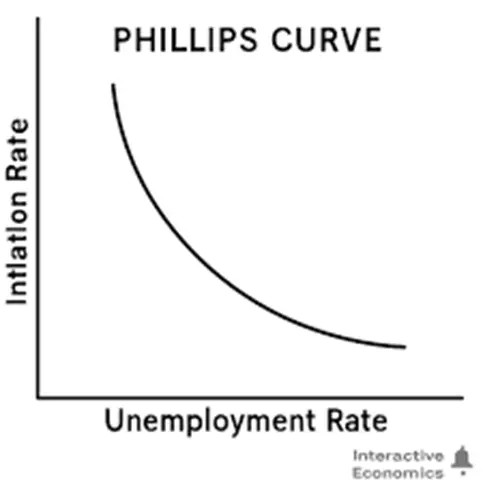
Under normal conditions, inflation and unemployment tend to move in opposite directions.
A relationship captured by what is called the Phillips Curve. As we can see in the chart below.
Source: Interactive Economics
Strong economic growth creates jobs and lifts wages, but it also puts upward pressure on prices.
Conversely, weaker growth generally brings lower inflation but at the cost of higher unemployment.
Stagflation breaks that pattern: prices accelerate while growth stagnates and unemployment rises.
Why are people so wary of stagflation?
The combination of a cooling economy and higher prices gives policymakers a real headache.
The classical policy response to higher inflation is to tighten interest rates and reduce government expenditure, to curb spending and “squeeze” money from the system.
The usual economic response to a weaker or weakening economy is to cut interest rates and adopt looser fiscal policy. This involves cutting taxes and increasing government spending to add money to the economy.
More recently, QE or quantitative easing has been used by central banks to boost demand/spending in their local economies.
Cutting interest rates and tightening spending might help curb inflation, but it's also likely to hinder a weak economy further.
Whilst a looser fiscal policy, increased spending and QE may provide a boost for a weak economy.
They are also likely to create additional demand and thus push inflation higher.
On that basis, as a policymaker, you can end up with a situation where you are “damned if you damned if you don’t.”
What causes stagflation?
Like most economic regimes, stagflation isn't caused by just one thing, but by a variety of factors which occur in unison.
However, something that is always present when stagflation raises its ugly head is an external price shock, and they tend to have their roots in the energy markets.
Stagflation is most closely associated with the 1970s, which were dogged by energy crises, as the oil-producing nations under OPEC, led by Saudi Arabia, asserted themselves.
By, for example, launching an embargo against sales of crude oil to the US and other Western nations in 1973.
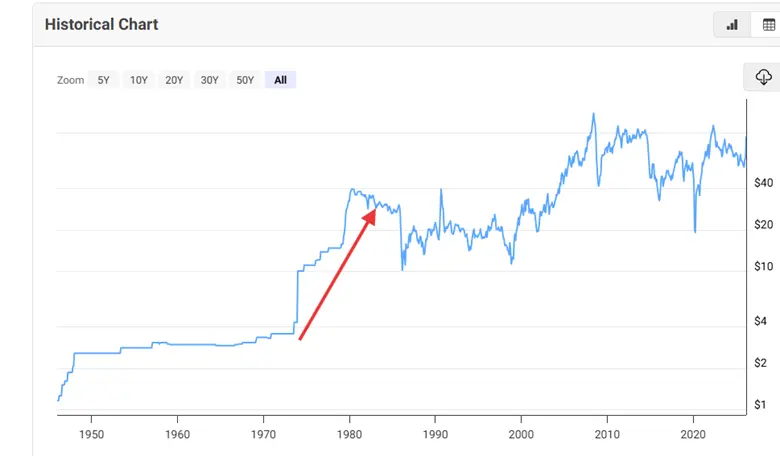
An action that saw the price of crude oil almost quadruple.
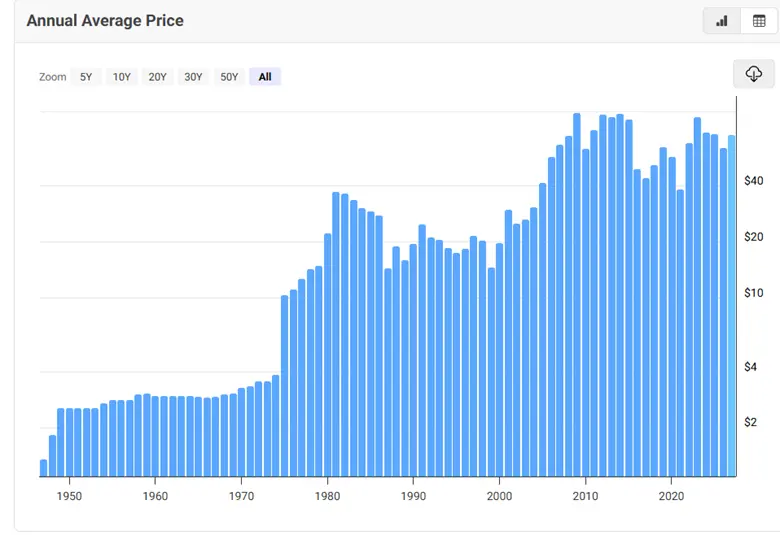
Truth told, the price of crude oil has effectively trended higher ever since, as we can see below.
Crude oil price chart (US$ per barrel)
Source: Macrotrends
The long-term uptrend in oil prices is clearly visible in this column chart, which shows the annualised average price of oil in dollars per barrel since 1946.
Source: Macrotrends
Supply and demand
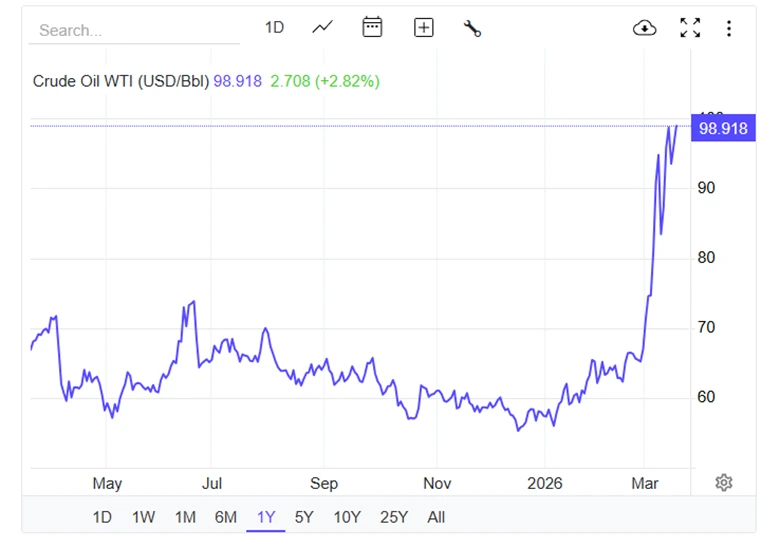
The oil price jumps when there is an interruption to the supply of oil.
Most recently, we have seen crude prices jump by some +48.0% as war with Iran broke out.
Iran controls the strategically important Straits of Hormuz. A narrow waterway which oil tankers must navigate to reach the open sea, making them easy targets for Iranian drones and missiles.
Oil installations in neighbouring countries have also become targets for Iran's military. So for the moment at least, the vast majority of crude production from the Persian Gulf is off limits, and while it is, oil prices will stay elevated.
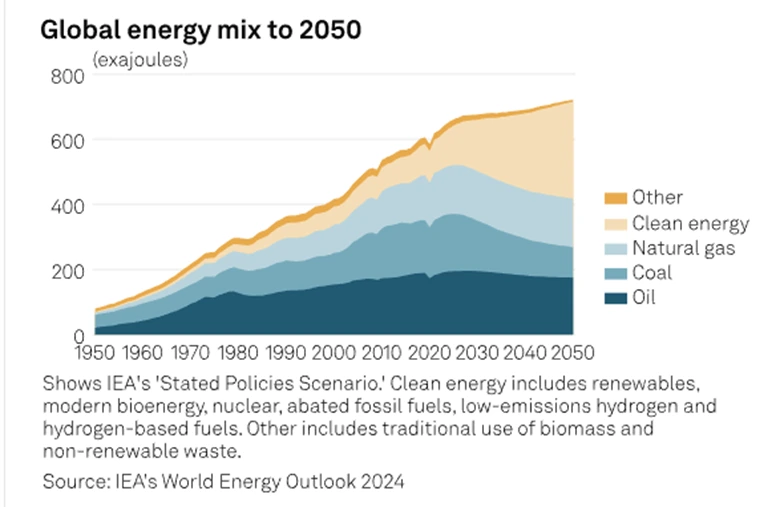
Oil is going to be a significant part, perhaps the largest part, of our energy mix for the foreseeable future, and while it is, our economies will be vulnerable to the external price/supply shocks that can stir up stagflation.
Expected global energy mix to 2050
Source: S&P Research / IEA
Who is vulnerable to stagflation?
The US, which was hit very hard by the oil crises of the 1970s, has since become one of the world's largest crude producers, and so to some extent it's insulated from the oil price, and could even be said to benefit from the sharp spike in crude.
However, some economies in Europe have become increasingly dependent on imported oil and gas in recent years. And they have already been hit hard by the supply shock caused by Russia's invasion of Ukraine.
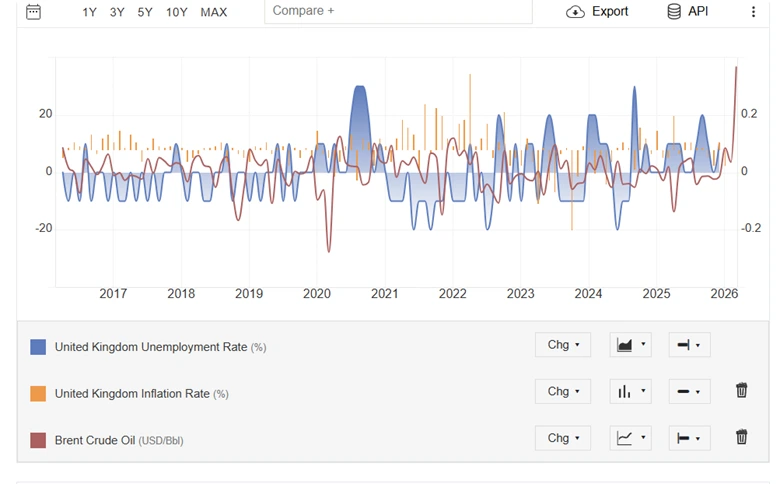
The UK is a prime example, as the chart below shows.
Unemployment in Britain is rising and hit 5.20% in December 2025.
At the same time, GDP in the country (not shown on the chart) is flatlining, as the government's economic policy fails to gain traction or create growth.
Source: Trading Economics
For now, inflation in the UK is relatively benign, but the Bank of England has paused its program of interest rate cuts while it takes stock of price pressure in the economy.
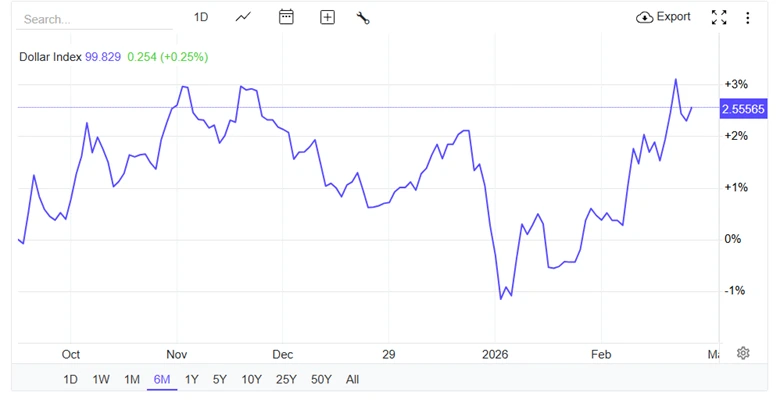
A weaker US dollar may also be helping the UK, as a stronger British pound has more purchasing power in dollar terms under these conditions. But in recent weeks, the dollar has been strengthening or at least has stopped going down, so that benefit may not last.
US Dollar Index Percentage Change
Source: Trading Economics.
Stagflation isn’t with us yet, and hopefully it won't be anytime soon. However, some of the seeds are definitely being sown.
A prolonged war with Iran and or a major blow-up in the private credit markets could act as the catalysts that tip economies into it.
The information provided does not constitute investment research. The material has not been prepared in accordance with the legal requirements designed to promote the independence of investment research and as such is to be considered to be a marketing communication.
All information has been prepared by ActivTrades (“AT”). The information does not contain a record of AT’s prices, or an offer of or solicitation for a transaction in any financial instrument. No representation or warranty is given as to the accuracy or completeness of this information.
Any material provided does not have regard to the specific investment objective and financial situation of any person who may receive it. Past performance is not a reliable indicator of future performance. AT provides an execution-only service. Consequently, any person acting on the information provided does so at their own risk. Forecasts are not guarantees. Rates may change. Political risk is unpredictable. Central bank actions may vary. Platforms’ tools do not guarantee success.