The beta stock measure tells traders how sensitive a stock price is when compared to overall market movements. This lets them see how strongly they can expect to see it react to short-term trends.
It’s an important factor to take into account when opening or managing positions. By understanding if it’s likely to be more or less volatile than the index it’s included in, traders can see what risks and opportunities it presents compared to other options in the same market but with a different beta coefficient.
What is Stock Beta in Trading?
The meaning of beta stock shows a stock's expected volatility or risk in relation to the market in general. For example, when looking at a stock in the S&P 500, the beta score will reveal how traders can expect to see it move when compared to the overall index.
The market or index is given a beta score of 1.0. This can be used to define which stocks are high beta, low beta, or negative beta compared to this baseline. Getting to grips with this helps traders anticipate what moves a particular stock might make.
This is the reason why some stocks move more than the market, while others move less. By looking at the beta risk and opportunity, traders can look to match the stock’s profile to their expectation of upcoming market movements.
How the Beta Coefficient Measures Market Risk in Trading
Knowing the main types of market beta data helps to understand how the beta score may influence certain stocks.
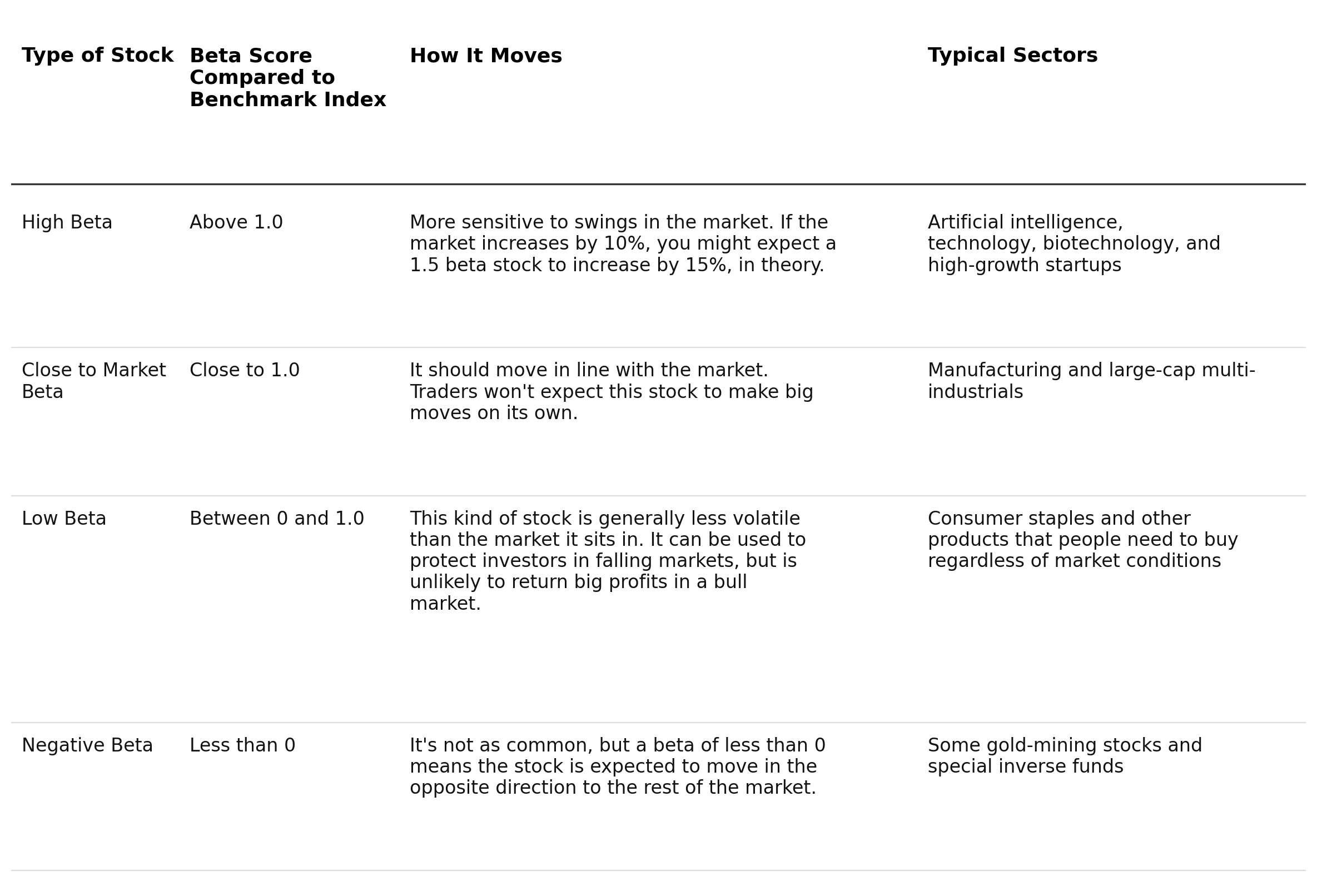
The table above shows that the beta level lets traders get to grips with the risk of any stock.
The higher the risk, the greater the chance of the stock having a big price movement either up or down. This means that they may offer more trading opportunities, but traders need to be aware of the possible downside too.
The current market conditions need to be taken into consideration when traders look at this issue.
How to Interpret Stock Beta in Trading
The market beta figure is calculated by taking the historical returns of a stock and comparing them with the market index. Known as regression analysis, this involves putting the figures for several years on a graph and plotting the best fit through the points.
- If this process gives a steep line, it means that the stock has moved more aggressively than the market, making it a high beta.
- A flat line makes it a low beta.
- A 45-degree line means its beta is exactly 1.0.
The exact formula is as follows: β=Variance(Rm)Covariance(Re, Rm). In this formula, Re is the individual stock’s return, and Rm is the market’s total return.
Of course, the main limitation of this model is that it only looks backwards. We can only see how their stock price has moved compared to the market in the past, so it doesn’t guarantee future results. Traders should also be aware that any change to a company’s business model will affect the expected results.
The Indices Trading page shows how many leading indices are currently performing. By adding this information to the beta stock details for an asset, a trader can work out what might happen next.
Traders generally use trading platforms and charting tools to quickly assess the current beta level. Manual calculation isn’t relevant for making active trading decisions, as charting tools calculate beta stock levels in just a moment.
Using Stock Beta to Identify Trading Opportunities
A beta portfolio and market analysis can be used to work out an approach that suits each trader. They select assets and adjust their position exposure based on volatility and future expectations.
What is a good beta for a stock? It really depends on risk attitude and expectations. A high beta strategy could be suitable for a trader who is feeling bullish about the market direction and wants to capitalise on any movement.
However, a low beta strategy could be more useful for a conservative approach. This could also be the chosen strategy for someone who wants to protect their capital during a period of high volatility.
The right beta stock is the one that matches the trader’s current strategy and the market conditions. This is an aspect that changes over time, to align with the market direction and potentially avoid excessive volatility.
Naturally, the beta risk is just one aspect to be considered when looking at a trading strategy. Using it along with other analysis methods helps traders to make a decision about which stock to choose at any given time.
Stock Beta FAQs for Traders
Is a High Beta Stock Better Than a Low Beta Option?
There isn’t really any better or worse option when it comes to stock beta levels. It simply comes down to which one is right for each trader’s current strategy and the market conditions.
Is a Negative Beta Stock a Bad Thing?
This is a fairly uncommon situation where the stock is seen to have moved in the opposite direction from the market index. It could hold back a portfolio during a bullish phase, but it could also act as a hedge in case the equity market suffers a drop.
Does the Beta Coefficient Tell Traders Anything About the Fundamental Health of a Company?
No, this number lets traders see the stock’s relative volatility level rather than its fundamental value. They might have a low bet but have worrying results or poor earnings that affect their future performance. The beta level only shows the stock’s past movement in relation to the overall market.
Does the Beta Stock Level of a Company Change Often?
This isn’t a static measure, but it also tends to move regularly. The beta level is worked out using a few years' worth of historical data. The beta may change if there is a major shift in how the business is operated, such as moving into a high-growth area like technology.
Why Are Traders Interested in High Beta Stocks?
Some day traders like the large intraday price range that they offer. Even if the market is relatively calm, a high beta stock can offer more opportunities to trade a big swing during the day.
The information provided does not constitute investment research. The material has not been prepared in accordance with the legal requirements designed to promote the independence of investment research and as such is to be considered to be a marketing communication.
All information has been prepared by ActivTrades (“AT”). The information does not contain a record of AT’s prices, or an offer of or solicitation for a transaction in any financial instrument. No representation or warranty is given as to the accuracy or completeness of this information.
Any material provided does not have regard to the specific investment objective and financial situation of any person who may receive it. Past performance is not a reliable indicator of future performance. AT provides an execution-only service. Consequently, any person acting on the information provided does so at their own risk.