
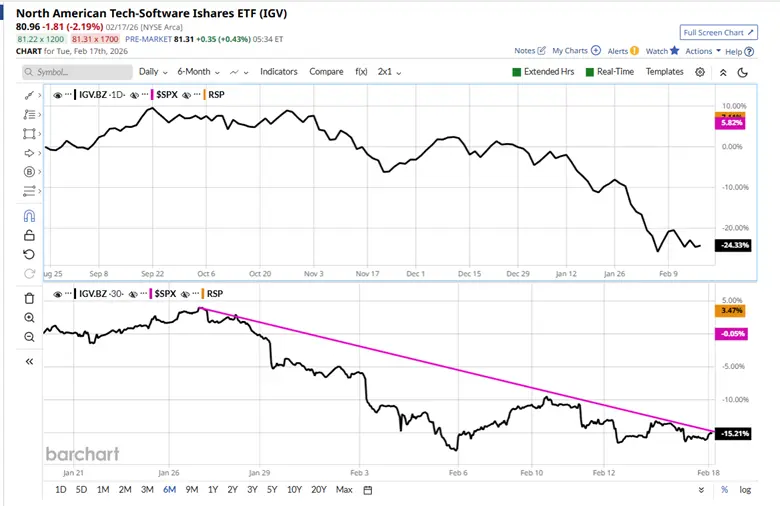
Software stocks have had a rough ride lately as we can see in the chart below of IGV ETF that tracks the sector in North America. The ETF is down by 18.0% in the last month and by almost 30.0% over the last 6 months
In fact the price of the median stock, in the applications software sector, is down by -37.0% from its high point, according to data from research house Lipper.
Making it the worst performing subset within the S&P 500 index.
IGV Percentage Change over 1 and 6 months
Source: Barchart.com
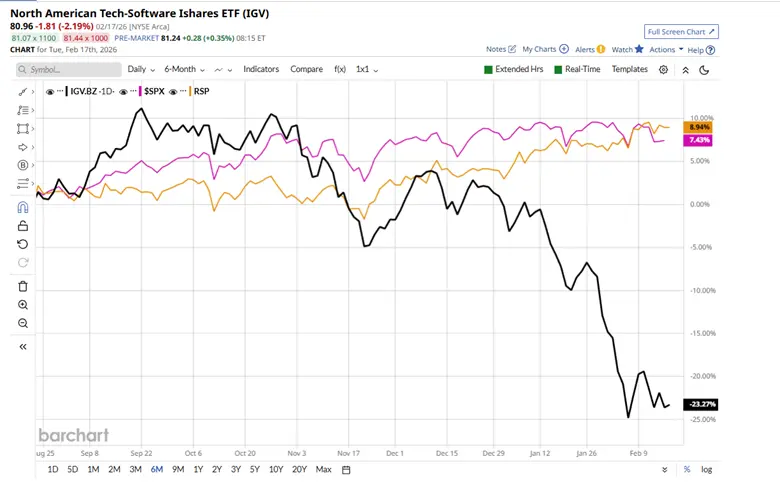
Our second chart shows the disconnect that has rapidly developed between the software ETF IGV (in black), the market cap-weighted S&P 500 Index (in pink) and the equalweight version of the S&P 500 index (in orange).
Source: Barchart.com
Sell-off or panicked markdown?
We have previously touched on the reasons for the software sell-off, but to recap investors are concerned about the impact that a new generation of large language models, and Agentic agents, could have on businesses that sell software as a service, often referred to as SAAS.
And in particular on the sectors recurring revenues and subscription income
To be clear we haven’t had any significant profits warnings or negative guidance from within the sector.
Instead the market reacted adversely to news of the release of new large language models, and the AI bot and market place known as Clawnet.
Some might argue that the “cart has been put before the horse” here.
And that the market has factored in “a worst case scenario” without any real world evidence or examples, to justify those conclusions.
Specialist research house Lipper, which is owned and operated by the London Stock Exchange Group, runs an earnings based model and prediction tool, known as Starmine.
One of the metrics that Starmine tracks are revisions to analysts earnings forecasts.
Essentially the numbers that Wall Street has pencilled in, for corporate America's earnings reports.
When we talk about a stock beating or missing estimates, it's these numbers that we are referencing.
Starmine not only tracks the analysts' forecast themselves, but also the direction that they are moving in.
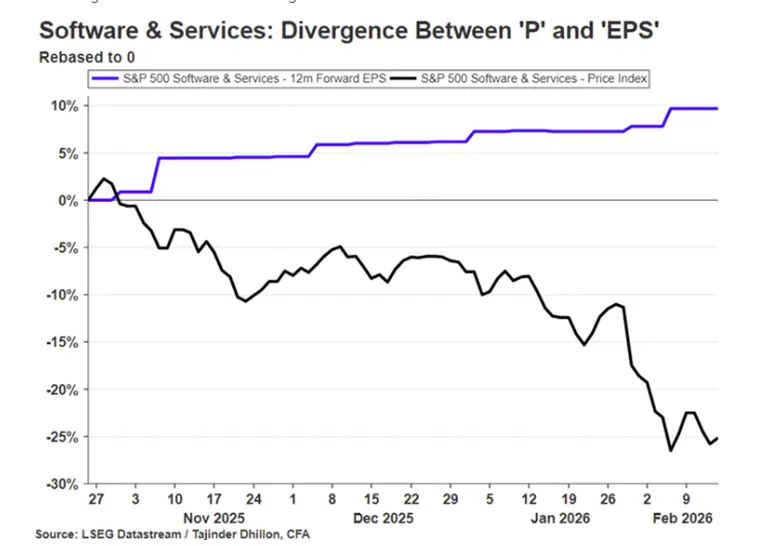
And this is where it gets interesting. Because as we can see from the chart below.
The 12 month forward EPS or earnings per share estimates, for software stocks, have been rising (the purple line) even as the price of the stocks (the black line) has cratered.
Source: LSEG/Lipper
High Hopes
Analysts now expect the sector to deliver earnings growth of +13.40% in 2026, alongside a +12.90% growth in revenues, and net margins of +29.30%.
That doesn't sound like an industry that’s on its knees to me.
At the same time the price earnings, or P/E ratio, for stocks in the sector, has shrunk dramatically.
Think of the PE as the premium or multiple that traders and investors are prepared to pay to own, or have exposure to a company's future earnings.
PE ratios are the metric on which stocks are valued, compared or rated.
The average P/E ratio in the Software sector has fallen by -25.0% in a matter of a few weeks.
Down from 32.6 times earnings in late October, to around 22.70 times currently
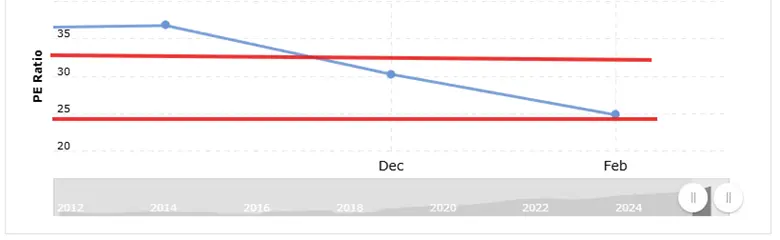
Here is what’s happened to Microsoft’s PE ratio as an example.
Microsoft MSFT P/E Ratio change October 2025 to February 2026
Source: Macrotrends.net
Lipper points out that the software sector now trades at its smallest premium to the S&P 500 since 2013.
It makes no sense for one half of Wall Street to be raising its expectations for the software sector, whilst the other half, are selling the stocks hand over fist.
One of those views is wrong
Either analysts' earnings forecast will need to come down sharply, or else the market has misjudged the impact of AI on the sector’s revenues and profitability.
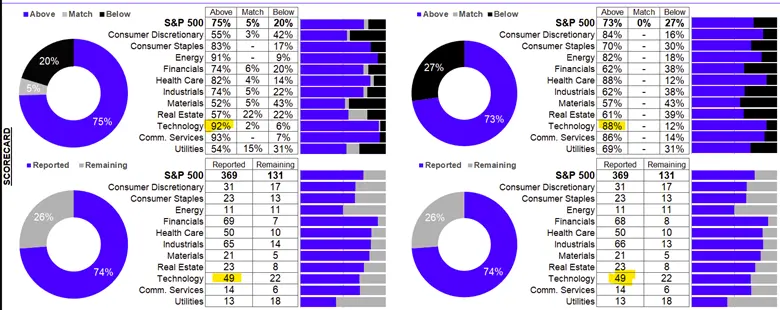
If we look at Lipper’s S&P 500 Earnings scorecard, for Q4 2025 as of the 13/02/2026 (see below)
We find that among the Technology companies (which includes software)that have reported, 92.0% have beaten estimates on earnings. Whilst 88.0% beat on revenues.
Source: LSEG/Lipper
What's more the surprise factor for those earnings beats was +7.50%, with +3.0% upside surprise for revenues.
We may not have long to wait before we find out which view point is wrong
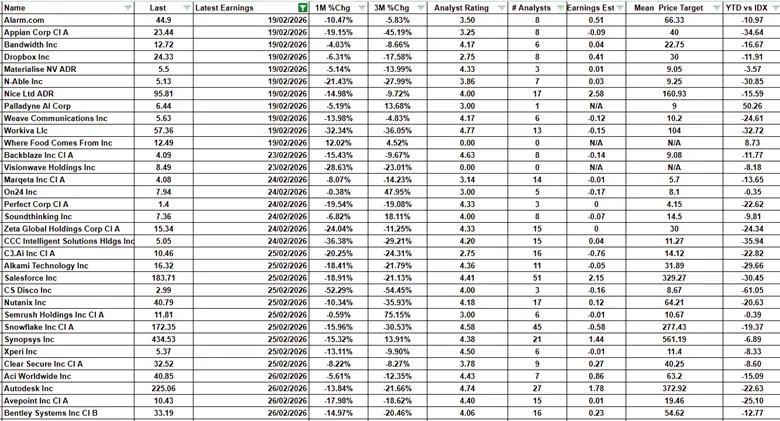
The table below shows a selection of stocks in the Software industry that are due to report earnings over the next couple of weeks.
We can also see the analysts consensus rating on the stocks, which are ranked out of 5. A score of 5.0 being the most highly rated, and a score of 1.0 being the least.
We also see the number of analysts that cover the stock, and the average or mean price target, amongst the analysts for that stock.
A selection of stocks in the Software industry, that are due to report earnings over the next few of weeks
It promises to be nothing if not interesting over the next couple of weeks and beyond.
The information provided does not constitute investment research. The material has not been prepared in accordance with the legal requirements designed to promote the independence of investment research and as such is to be considered to be a marketing communication.
All information has been prepared by ActivTrades (“AT”). The information does not contain a record of AT’s prices, or an offer of or solicitation for a transaction in any financial instrument. No representation or warranty is given as to the accuracy or completeness of this information.
Any material provided does not have regard to the specific investment objective and financial situation of any person who may receive it. Past performance is not a reliable indicator of future performance. AT provides an execution-only service. Consequently, any person acting on the information provided does so at their own risk. Forecasts are not guarantees. Rates may change. Political risk is unpredictable. Central bank actions may vary. Platforms’ tools do not guarantee success.