Objects in orbit around our planet are constantly falling back towards the Earth.
The height of the object's orbit determines how long it takes for that orbit to decay.
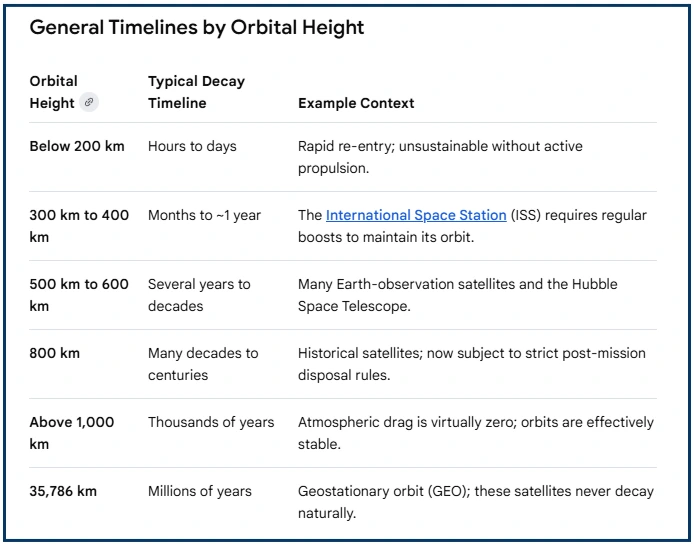
Relatively small differences in the height of an object's orbit directly affect the time it spends rotating around the Earth. The table below outlines the effects of a higher orbit on longevity.
Source: Gemini AI
The higher you go, the slower the rate of decay is, according to the rule of thumb, until you get to a geostationary orbit, almost 36000 kms above the earth.
You are probably wondering what any of this has to do with the markets
Well, quite a bit, actually, the idea that what goes up must come down is a cornerstone of trading and investing.
I was recently asked about my thoughts on taking profits. How do I know when it's time to close a profitable position? Did I have specific levels or signals that tell me it’s time to come out?
My answer probably surprised the person who asked me the question. I replied when they stopped going up.
That may sound simplistic, perhaps even juvenile, but it wasn't a flippant answer.
One way or another, most of my ideas can be thought of as being driven by momentum, and when that momentum slows and starts to decay, it's probably time to close part or all of the position.
That momentum decay can be likened to the orbital decay experienced by satellites flying above the Earth.
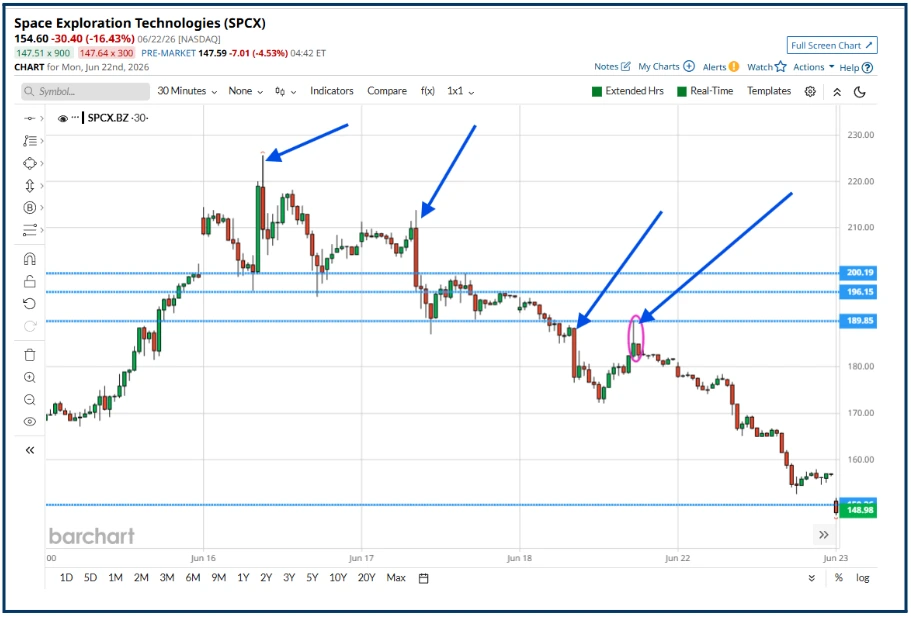
Starlink, a subsidiary of SpaceX SPCX US, operates a fleet of around 10,400 low-earth orbit satellites. SpaceX shareholders got a reminder about the force of gravity of its financial equivalent
Momentum decay in Monday's session, with the stock falling by almost -16.50% in a single session
Source: Barchart.com
SpaceX is now some -32.0% below its post IPO highs. Looking at the 30-minute chart of the stock, it’s pretty clear that there were clues about the direction of the path of least resistance, and to be honest, anybody who saw this chart or one like it and went long ahead of, or just after the holiday weekend in the US was asking for trouble.
I put the recent moves lower in SpaceX down to the price discovery process; the market is still getting acquainted with a new issue, trying to identify areas of supply and demand, gauging how the stock reacts to new information and news. What index membership will mean for supply and demand in the stock? And whether there will be a flood of insider selling, when the post IPO handcuff come off?, and so on.
SpaceX hasn't hit escape velocity as yet
“Escape velocity is the minimum speed an unpropelled object must reach to break free from the gravitational pull of the Earth”
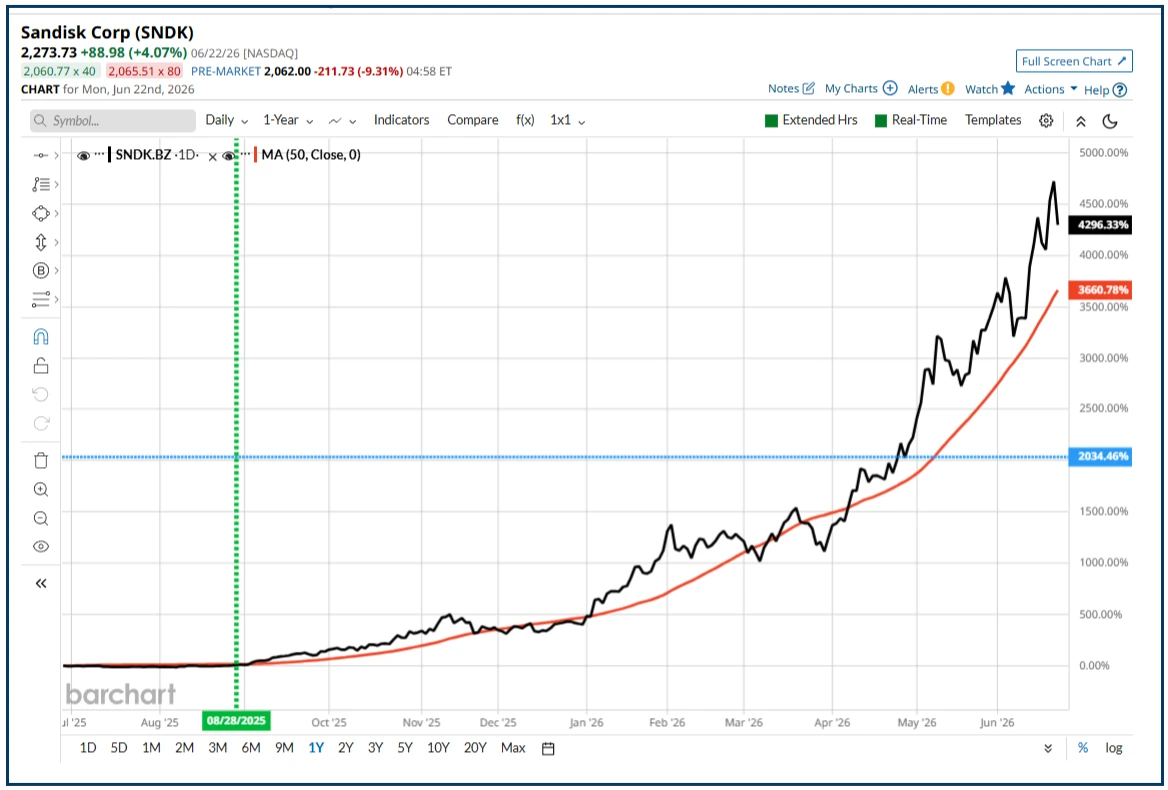
Here is an example of a stock that has made that breakthrough. Sandisk SNDK, which is up by almost +4600% since August 2025.
Source: Barchart.com
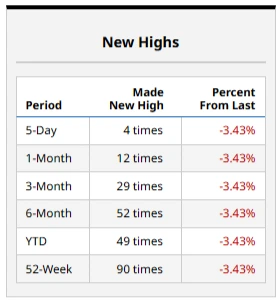
From a momentum perspective in SNDK, two things stand out: Firstly, the number of new highs it’s made over the last 52 weeks: 90. That’s the second highest total among the S&P 500 stocks, it’s only beaten by Ciena CoЗrp CIEN US, which has posted 95.
SNDK US new period highs.
Source: Barchart.com
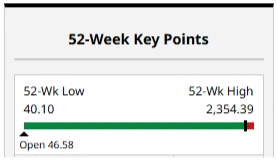
Secondly, Sandisk’s positions within its 52-week range says so much about its internal momentum.
SNDK US 52-week range/ current position
Source: Barchart.com
Sandisk may not stay at these levels/go higher forever, but the longer it stays at these prices, the harder it becomes to knock it off its pedestal, or does it?
I say that because the stock has to justify its rating, with a PE ratio greater than 34.0 times and a price that's already $400.00 above the analyst's consensus price target of $1863.0.
The technology sector could be tested from here.
South Korea's Kospi Index sold off by-10.00% on Tuesday morning, whilst Alphabet GOOGL US lost -4.99% on Monday as a key AI researcher left the company to join Anthropic.
How well a stock, or a whole stock market, performs under pressure is the real test of its quality.
Watch this space.......................
The information provided does not constitute investment research. The material has not been prepared in accordance with the legal requirements designed to promote the independence of investment research and as such is to be considered to be a marketing communication.
All information has been prepared by ActivTrades (“AT”). The information does not contain a record of AT’s prices, or an offer of or solicitation for a transaction in any financial instrument. No representation or warranty is given as to the accuracy or completeness of this information.
Any material provided does not have regard to the specific investment objective and financial situation of any person who may receive it. Past performance is not a reliable indicator of future performance. AT provides an execution-only service. Consequently, any person acting on the information provided does so at their own risk. Forecasts are not guarantees. Rates may change. Political risk is unpredictable. Central bank actions may vary. Platforms’ tools do not guarantee success.