
If the extreme swings in the market seen on Monday, 23rd of March caught you out, don’t feel bad about it because nearly everybody else was in the same boat.
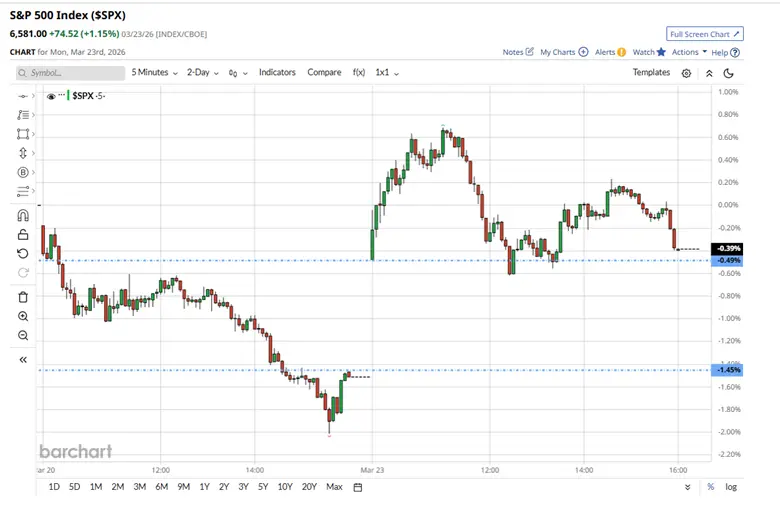
The S&P 500 index, which represents as much as 60.0% of the global market cap, isn't supposed to move the way it did on Monday, gapping higher by +2.0%.
You can understand why it happened
President Trump tweeted what, on the face of it, looked like good news: hopes of a negotiated end to the war with Iran, and suggestions that the two sides had been talking over the previous weekend.
Cue an enormous relief rally
The only problem was that the Iranians said that they didn't know anything about it (twice); of course, those denials could have been for domestic and regional consumption, even if talks were taking place in the background. We may never know for sure.
The S&P 500 gapped higher
Source: Barchart.com
The unpredictability of war is why I wrote about Risk Management three weeks ago. I said then that:
“When market dynamics change, so should your approach to risk.
Uncertainty raises volatility, prices become more volatile and harder to predict. Previous ranges and other statistics about price action become less effective because the psychology of traders changes in these situations. Where traders were outright bullish, they became more cautious, and if fear gets a grip, then it can oust greed and create bearish sentiment.”
President Trump also said there would be a five-day moratorium on further strikes on Iran to provide a window for “ negotiations” to continue (conclude?) and for the Strait of Hormuz to reopen.
Once again, we don't know what the reality of the situation is. However, Canadian Broker RBC (which is well respected for its energy commentary) wrote on Tuesday that even if talks had been ongoing
“ They were sceptical that we are just days away from a lasting deal “
The bank also pointed out that a younger, more hardline cohort is now in power in Iran. And that recent events have reduced their need to make concessions to Washington.
A quick fix seems unlikely, but until we get clarity either way, we need to exercise caution and adopt a disciplined approach to risk management, and if we do trade, we should do it tactically and with our eyes wide open.
The market has changed
While we are waiting for clarity, we can use the time to do some research to get a feel for the new regimes and narratives that are driving the market. Macro news and geopolitics are at the top of the tree, and we are playing a waiting game there.
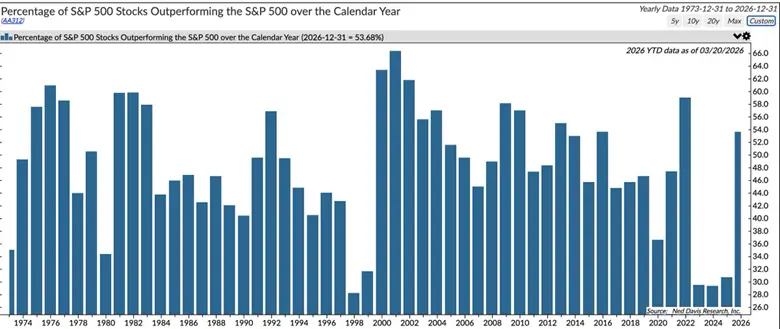
But we can look at market internals, for example, this chart from strategist Seth Golden, which tracks the percentage of stocks that are outperforming the S&P 500 over a calendar year.
Which now sits just below 54.00%
And whilst that’s a big improvement from the readings in 2022-2025, it's well below the levels seen in the early 2000s. I have previously written a lot about risk concentration and leadership in the S&P 500.
The data could suggest that we are heading back to a regime where what happens to the biggest stocks (Mag 7 and technology) is all that matters, whereas between November 25 and mid-February, when an “anything but tech” narrative was driving the market.
Source: Seth Goden
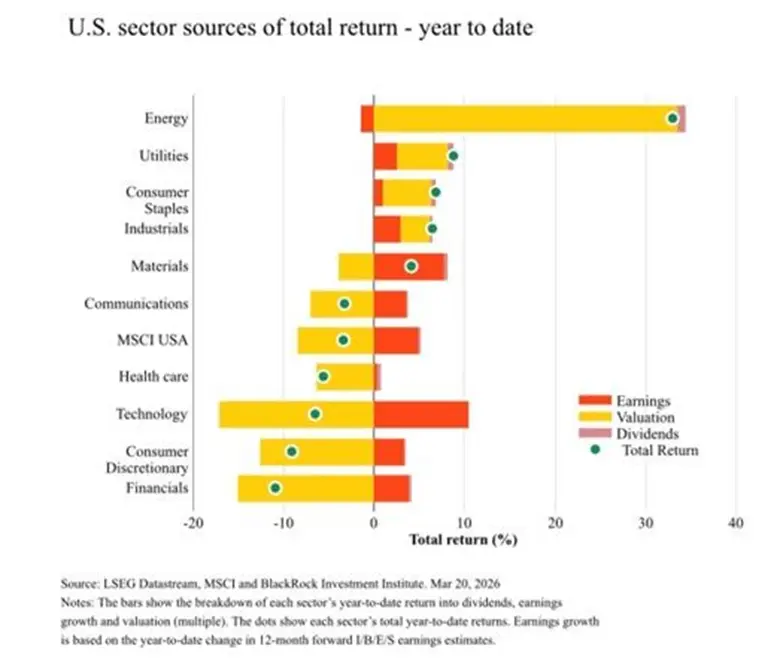
If technology is back in favour, this could be the reason why.
Share prices in the sector have been hit hard, but at the same time, earnings in the sector ( shown in red below ) have outperformed the competition. Materials is the only sector to come close at the current time.
Source: Blackrock
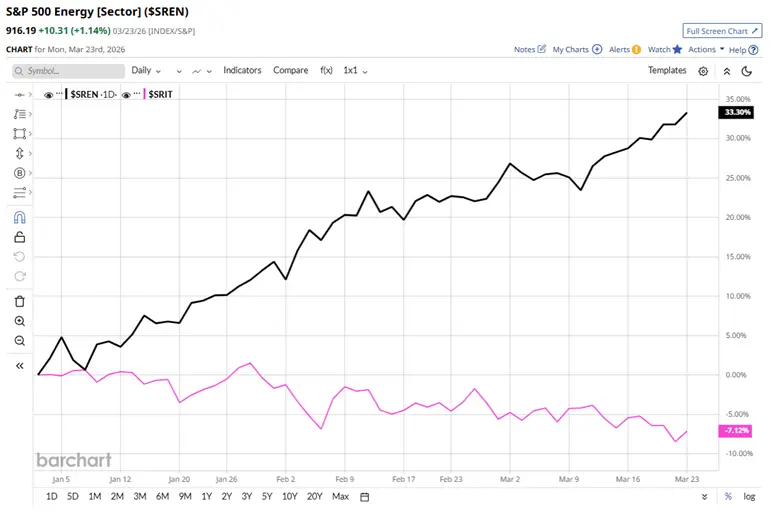
If the war does end in the not distant future, could there be a rotation out of Energy (assuming a lower oil price) and into Technology? The yellow bars above measure valuation (price performance). Energy has soared while Technology has slumped for much of 2026 to date.
Energy vs Technology Year to Date % Change
Source: Barchart.com
There is a huge gap year to date between the performance of these two sectors, big enough to allow us to be tactical and to wait for definitive confirmation that it is narrowing (or widening further?) before taking a trade.
Discretionary Trading
Consumer Discretionary stocks have been hit hard since the war started almost a month ago.
Airlines have taken some of the biggest blows.
Fuel prices are rising, refined jet fuel is becoming scarcer, and major airport hubs and destinations in the Persian Gulf are effectively off limits while the conflict continues.
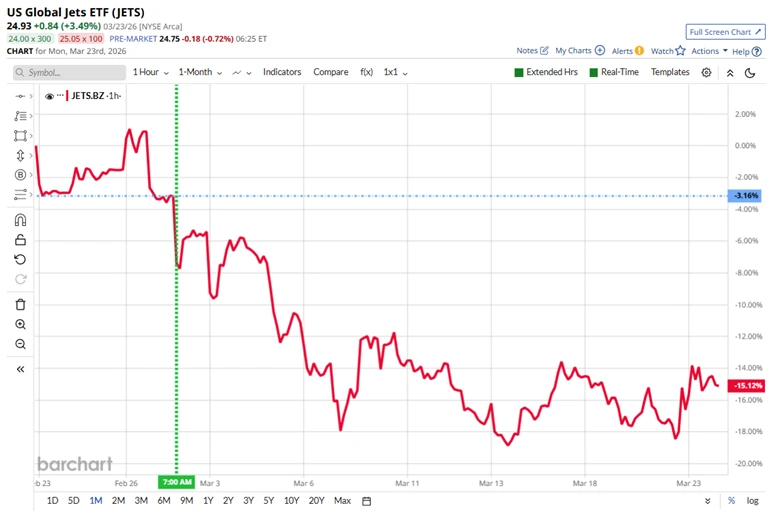
The Jets ETF JET US tracks the Airline sector. As we can see below, the ETF has fallen by more than -18.0% since hostilities began.
Jets ETF performance in 2026
Source: Barchart.com
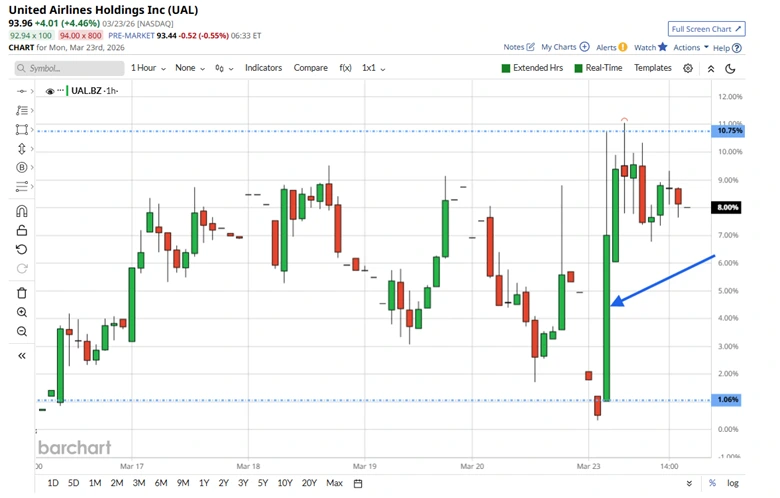
US carrier United Airlines UAL saw its stock price jump by +9.0% on President Trump's tweet, before selling off once more.
It's tempting to think that any concrete evidence of negotiations. Or a re-opening of the Strait of Hormuz to tanker traffic could produce a similar response. Of course, the longer the war goes on, the harder it's likely to be for the aviation business.
Source: Barchart.com
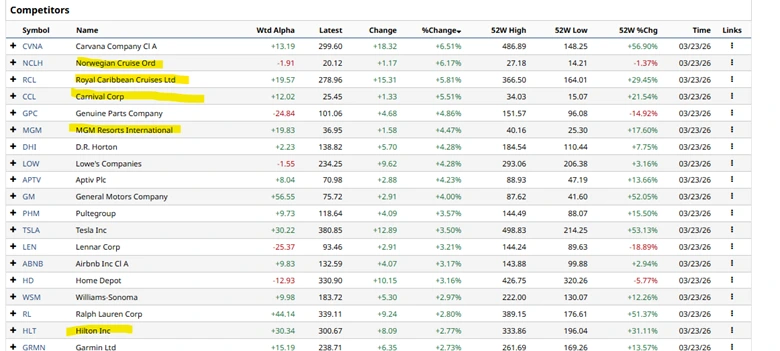
Cruise lines, casinos and hotels were among other Consumer Discretionary stocks that rallied on the Trump comments.
CD stocks- trading higher, post the Trump comments
Source: Barchart.com
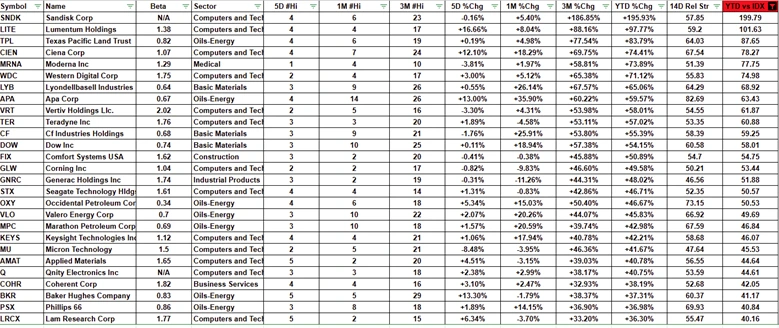
Let's finish with a look at those stocks in the S&P that have outperformed the Index in 2026.
I have created a list of those stocks that outperformed the index by +40.0% or more year to date (YTD vs IDX), and have shown it in descending order.
What's interesting is that a lot of the names in the list are drawn from the Technology sector, and almost as many are from Energy.
The tech stocks are predominantly chip makers or are in other high-end niches. It's not impossible that these stocks could rally again on an end to hostilities, as some of their key raw materials, such as helium, originate from the petrochemical plants in the Middle East.
Outperforming the S&P 500 by +40.0% or more
Source: Barchart.com/Darren Sinden
The presence of so many tech stocks in the outperformers list might seem to contradict the comments made earlier in the article. However, my view is that it shows us that right now, nothing is straightforward, and we need to dig into any opportunities that present themselves, and be selective, but then that's what good stock picking is all about.
The information provided does not constitute investment research. The material has not been prepared in accordance with the legal requirements designed to promote the independence of investment research and as such is to be considered to be a marketing communication.
All information has been prepared by ActivTrades (“AT”). The information does not contain a record of AT’s prices, or an offer of or solicitation for a transaction in any financial instrument. No representation or warranty is given as to the accuracy or completeness of this information.
Any material provided does not have regard to the specific investment objective and financial situation of any person who may receive it. Past performance is not a reliable indicator of future performance. AT provides an execution-only service. Consequently, any person acting on the information provided does so at their own risk. Forecasts are not guarantees. Rates may change. Political risk is unpredictable. Central bank actions may vary. Platforms’ tools do not guarantee success.