
Not everyone agrees on the best short-term trading style. The swing trading vs day trading debate reveals how both of these approaches have become extremely popular. Both strategies look to take advantage of the liquidity and volatility in the markets, but differ in their execution.
We’ll be looking at the main factors, such as time commitment, risk exposure, profitability potential, and psychological demands. Find out the most crucial aspects of day and swing trading that you need to take into account.
Intraday vs Swing Trading – Core Differences
The big difference between day and swing trading is the fact that day trading is carried out on a single day. Positions are never left open overnight. On the other hand, swing trading positions can be left open over several days or weeks.
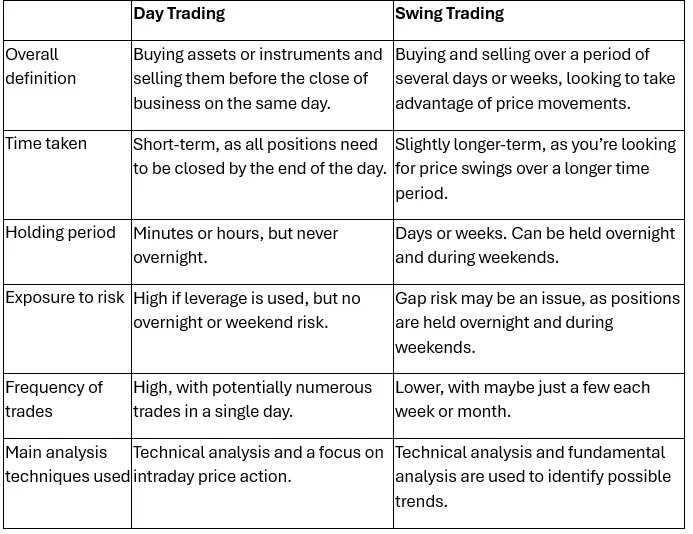
When we look at intraday trading vs swing trading in this way, it becomes clear why they are ways of trading that appeal to different kinds of traders.
With the question of swing trading vs day trading - which is more profitable, this is something that depends on various factors, meaning that there is no simple answer.
Risk, Time Commitment, and Psychological Pressure
If we now look at swing trading vs day trading from the trader’s point of view, we can see that there are also some important differences between them. As well as the purely financial aspect, the cost of trading can also be measured in areas like time and mental energy spent doing it.

As we’ve seen, the differences in day and swing trading become more evident when we look at them in this way. The likes of screen time and emotional stress need to be taken into account when deciding which strategy to use.
Swing Trading vs Day Trading – Which Is More Profitable Today?
Every trader needs to decide which strategy to use, taking into account those factors we looked at earlier. Therefore, you should be starting to see which one is most likely to fit your lifestyle and risk profile.
There is no definite answer to the question of which is more profitable. Even if you stick to just one of them, your results are likely to vary according to market conditions. Both strategies offer different paths that could lead to growth, but neither guarantees success.
The key lies in choosing between day trading vs swing trading based on your profile and the current market conditions. If the stock market is showing a clear trend, you might consider that swing trading is the best approach.
The risk management aspect is worth considering. Day traders need to manage their trades extremely closely, as just one loss could ruin their week’s results. Swing trading is less intense in this respect, as you might have fewer profitable trades but still come out ahead.
Market volatility is also important in the difference between day trading and swing trading. Day trading tends to work better in highly volatile markets when the prices fluctuate throughout the day.
Swing trading is more effective in a trending market where the direction is clear over several days. Following the latest market news is still crucial, but you can do so with longer timeframes.
How strictly you follow your strategy is another of the main issues to think about. Good strategy discipline is needed in both cases. You need to control your emotions in day trading and be patient in swing trading.
In terms of costs and spreads, day traders carry out far more trades, so they pay more in terms of these expenses. This is a cost that needs to be taken into account when calculating profits, as is the overnight swap rate in swing trading.
When Day and Swing Trading Make More Sense
Choosing when to choose between intraday vs swing trading isn’t about finding a perfect trading strategy that never fails. Instead, it’s a matter of choosing the right fit for your current situation and the market.
There are really four main areas you should take into account that will help you decide.
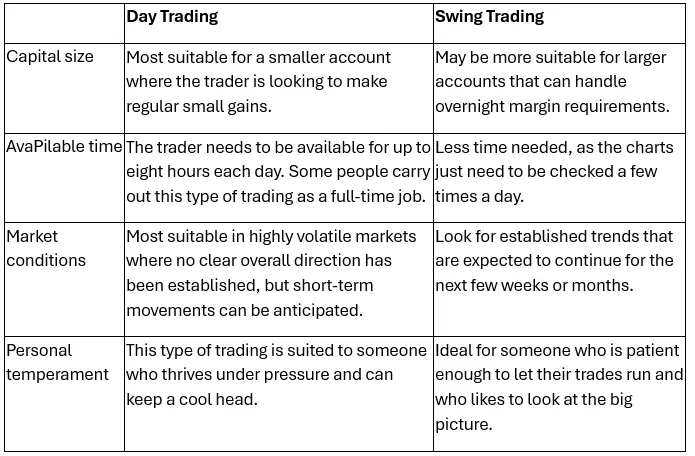
Having looked closely at swing vs day trading strategies, you can now make an informed decision about which one is right for you. You can’t expect to profit from every trade, but choosing the most suitable approach is going to give you the best chance of success.
Swing Trading vs Day Trading – FAQs
Can Day and Swing Trading Be Carried Out Alongside a Full-Time Job?
Both of these trading strategies can be carried out by someone in full-time employment. However, you should be aware that day trading requires a much bigger time commitment, with some people spending up to eight hours a day on it.
What Risks Are Involved in Holding a Position Overnight on Swing Trading vs Day Trading?
The main risk is that a major event occurs when the market is closed. This can cause the price to jump immediately when the market opens the following day. Day trading doesn’t involve overnight positions, so this risk only exists with swing trading strategies.
Are the Same Technical Analysis Factors Used for Intraday vs Swing Trading?
You can use similar data, but the interpretation may vary. For example, you’ll be looking at the smaller timescales on the candle. In the same way, an RSI (relative strength index) reading could mean different things based on your time preferences.
The information provided does not constitute investment research. The material has not been prepared in accordance with the legal requirements designed to promote the independence of investment research and as such is to be considered to be a marketing communication.
All information has been prepared by ActivTrades (“AT”). The information does not contain a record of AT’s prices, or an offer of or solicitation for a transaction in any financial instrument. No representation or warranty is given as to the accuracy or completeness of this information.
Any material provided does not have regard to the specific investment objective and financial situation of any person who may receive it. Past performance is not a reliable indicator of future performance. AT provides an execution-only service. Consequently, any person acting on the information provided does so at their own risk. Forecasts are not guarantees. Rates may change. Political risk is unpredictable. Central bank actions may vary. Platforms’ tools do not guarantee success.